Angkor Wat
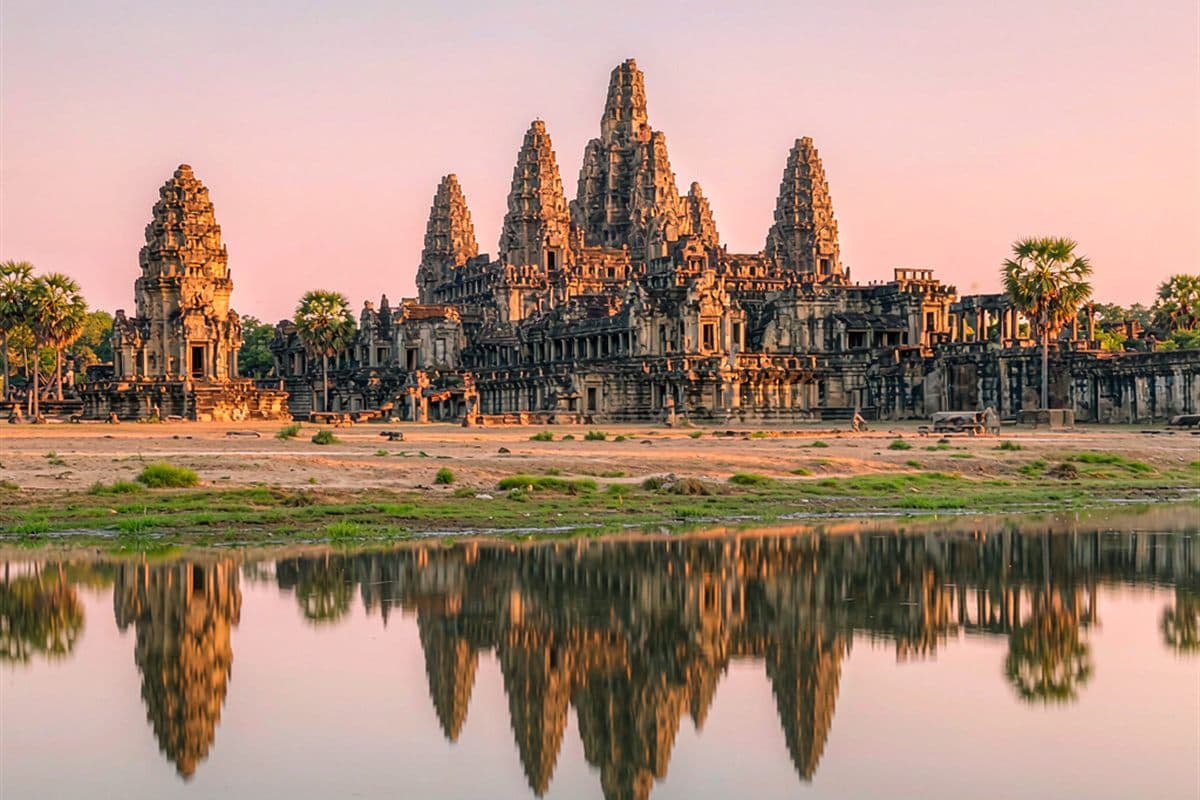
The greatest architectural legacy of the Khmer empire and the largest religious complex in the world — a dream of empire in jungle and stone.
Overview
Angkor Wat is the largest religious complex in the world and the defining monument of the Khmer empire, monumental in scale.
History
Angkor Wat was built in the early 12th century, around 1113 to 1150, by the Khmer king Suryavarman II, originally dedicated to the Hindu god Vishnu and later converted to a Buddhist temple. The complex covers about 162 hectares and its central tower rises 65 metres, aligned with such precision that it tracks particular astronomical events. After the Khmer empire declined the temple was swallowed by jungle for centuries until the French naturalist Henri Mouhot rediscovered it in 1860. It became a World Heritage Site in 1992.
Highlights
- •The perfect reflection in the lotus pond at sunrise
- •Gallery after gallery of exquisite mythological reliefs
- •The 216 enigmatic smiling stone faces of Bayon temple
- •Giant tree roots entwined with ancient stone at Ta Prohm
- •The monumental gateways of Angkor Thom
Practical tips
- •Arrive by 4 am to secure a spot for sunrise
- •A tuk-tuk is an efficient way to tour the temples
Practical information
- Best time
- November to February
- Tickets
- One-day pass USD 37, three-day USD 62, seven-day USD 72
- Opening hours
- 5:00 to 17:30; sunrise visits require early entry
- Local food
- Amok fish, Khmer curry and noodle soup
- Getting around
- Angkor is toured by hired car or tuk-tuk; set off early for sunrise
- Visa
- A visa on arrival or an e-visa applied for in advance is available. Angkor Wat requires a separate ticket and entry in an allocated time slot.
Traveller reviews
…